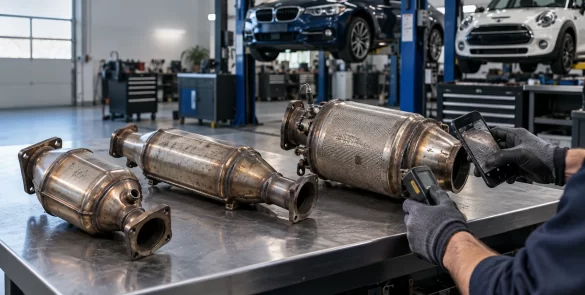
Introduction: A car catalytic converter helps reduce harmful substances in exhaust gases. When the part is worn out or damaged, it should not be stored in a garage or disposed of with household waste. Responsible recycling makes it possible to recover platinum, palladium, and rhodium while enabling the owner to receive a justified valuation.
- A worn-out part should first be identified and inspected.
- The code, model, and condition of the internal component are important for an accurate valuation.
- Sorting and analysis help determine the content of valuable metals.
- Safe handling reduces the risk of dust, material loss, and improper disposal.
- A documented offer makes it easier to compare acceptance terms.
- A responsible partner ensures a clear process from handover to payment.
Why should a worn-out part be recycled?
Recycling worn-out vehicle exhaust system components returns valuable materials to circulation. It also helps prevent improper storage and handling of waste.
In Latvia, requirements for the treatment of end-of-life vehicles establish responsible handling of parts and waste. A broader legal framework is provided by the regulations of the Republic of Latvia. Meanwhile, the European Commission explains the importance of end-of-life vehicle management in Europe’s circular economy.
Recycling is also important for practical reasons. A part’s internal core may contain recoverable metals, but their quantity is not the same for every model. This is why professional catalytic converter purchasing begins with identification rather than guesswork or an assessment based only on external appearance.
How does the recycling process work?
Recycling typically involves collection, identification, sorting, material preparation, analysis, and metal recovery. Each stage helps reduce losses and improve the accuracy of the final valuation.
- Collection and preparation – the part is accepted from a vehicle repair shop, scrap metal dealer, business, or private individual. Before further processing, it is checked for any unnecessary attached waste.
- Identification – a specialist looks for the code and determines the part type. Metalbee uses a database of more than 30,000 chemically analysed units to compare the submitted part with known samples.
- Sorting – units are grouped by construction, model, and condition. Separate sorting is necessary because different models may contain different quantities of valuable materials.
- Crushing and sample preparation – in a specialised environment, the internal material is prepared for analysis. Controlled work helps obtain a more uniform sample and limit material loss.
- Laboratory analysis – chemical methods help determine the content of valuable metals more accurately. Metalbee states that the work is carried out by experienced technicians with the support of a modern laboratory.
- Metal recovery – the prepared material proceeds to further recycling, where platinum, palladium, and rhodium are separated. The recovered materials can then be reused.
What is checked at each stage?
Each stage examines a different characteristic of the part: origin information, markings, completeness, the condition of the internal core, or material composition. This sequence creates a transparent path from acceptance to the final valuation.
| Stage | What is checked? | Why is it important? |
|---|---|---|
| Acceptance | The condition of the part and attached elements | Prevents unsuitable materials from entering the process |
| Identification | The code, type, and match with the database | Helps select the correct valuation method |
| Sorting | The construction and type of internal core | Reduces the risk of mixing different materials |
| Analysis | The content of platinum, palladium, and rhodium | Provides the basis for a documented offer |
| Payment | The valuation and transaction terms | Helps the customer understand the final result |
Three Recoverable Precious Metals
A used catalytic converter may contain platinum, palladium, and rhodium, but their amounts vary between models. That is why an accurate valuation begins with identification and analysis, not a guess based on outward appearance.
One of the valuable metals that can be recovered from a used catalytic converter through responsible recycling.
Palladium content can also affect the part’s valuation, making correct model identification important.
Rhodium is one of the recoverable metals listed, and its quantity can vary across different parts.
What is checked before an offer
How is the value of a part determined?
Value is determined by the identification, completeness, condition, and metal content of the part. An external inspection alone is not always sufficient, so database information and laboratory analysis can play an important role.
Catalytic converter prices are not the same for all vehicle models. If the part is missing its internal core, if it is damaged, or if it has been partially removed, the final valuation may differ from that of a complete and intact unit. You can read more about the importance of composition in the article on the impact of precious metals on catalytic converter value.
The search phrase catalytic converter purchasing prices often leads to general promises. However, an offer that clearly states how the part was identified and which data were used is more useful. This makes it possible to compare not only the final amount but also the quality of the valuation.
How should you prepare to hand over a part?
Before handing it over, retain the part code, photograph its exterior, and find out the vehicle make, model, and year of manufacture. The more complete the initial information, the faster a specialist can carry out the first identification.
- Do not remove the internal ceramic or metal core yourself.
- Clean only loose external dirt without damaging the markings.
- Prepare clear photographs showing the code and the overall condition of the part.
- Clarify the valuation and payment procedure before the transaction.
- If you submit several units, label them separately.
Catalytic converter handover becomes easier when the customer provides basic information in advance. Professional catalytic converter acceptance, in turn, includes inspection and a clear explanation of the process. The article on choosing a reliable recycling partner in Latvia summarises additional useful criteria.
How do you choose a reliable partner?
A reliable partner explains the identification method, the basis for the valuation, the recycling route, and the payment procedure. The customer should not have to rely solely on a verbal promise.
Metalbee highlights its laboratory capabilities, database of chemically analysed parts, and cooperation with leading recycling plants. The company also works with printed circuit boards and non-ferrous metals. Therefore, enquiries about buying old computers concern a different material stream than vehicle exhaust system components and should not be combined in a single valuation.
Some internet users search for catalytic converter buying using different spelling variations. Regardless of the search wording, it is worth checking whether the company can substantiate its valuation and offers understandable transaction steps.
How can you arrange acceptance in Riga?
First, send the part code, photographs, and any available vehicle information. After the initial communication, the inspection, delivery, and payment arrangements can be clarified.
If your search intent is catalytic converter purchasing in Riga, it is important to evaluate more than just location. Also check the accuracy of identification, transaction transparency, and whether the part is directed to responsible recycling. You can contact Metalbee by phone at +371 22836005 or +371 27714143, or by email at info@metalbee.lv.
Summary
Recycling catalytic converter components begins with collection and identification, continues with sorting and analysis, and ends with the recovery of valuable metals. The best result is achieved when the customer keeps the code, does not dismantle the part, and chooses a partner who can clearly justify the valuation. This approach helps reuse resources and makes the transaction safer and easier to understand.
Frequently Asked Questions
Can a damaged part also be handed over?
Yes, a damaged part can be submitted for valuation, but its condition may affect the result. A specialist checks whether the internal core has been retained, has not been removed, and has not lost a significant amount of material. The part should not be dismantled before handover. It is better to keep it in its current condition and send clear photographs.
Why is the part code needed?
The code helps identify the type of part and compare it with previously analysed samples in the database. This can speed up the initial valuation and reduce the risk of incorrect classification. If the code is unreadable, information about the vehicle make, model, year of manufacture, engine, and overall photographs of the part can be helpful.
Can a valuation be received based only on a photograph?
A photograph and code may be sufficient for initial identification, but they do not always reveal the actual condition of the internal core. A physical inspection or material analysis may be required for a more accurate final offer. Therefore, a remote estimate should be treated as the first stage of the process rather than an automatic final guarantee.
Why should the part not be dismantled at home?
Dismantling it yourself may damage the internal material, cause material loss, and make accurate valuation more difficult. Crushing and sample preparation require suitable equipment and a controlled working environment. It is safer to hand over the part in as complete a condition as possible and allow experienced specialists to inspect it.
What should be clarified before the transaction?
Before the transaction, clarify how identification is carried out, whether completeness is checked, and how the offer is justified. Also ask about delivery, documentation, and payment procedures. Clear answers help compare service providers and reduce the risk of misunderstandings after the physical inspection of the part.