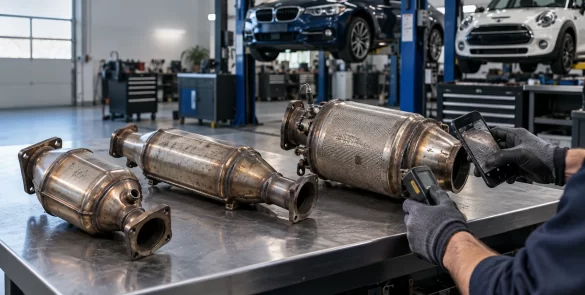
Introduction: A used catalytic converter is not just an old car part. It contains materials that can be recovered and reused. If the part is stored unnecessarily, thrown away, or handed over to an unverified buyer, it creates environmental, financial, and safety risks. That is why legal and transparent catalytic converter purchasing helps preserve resources and ensures a fair valuation.
- An unrecycled part means lost materials and unused value.
- Responsible recycling reduces the need to extract new raw materials.
- The value of a part cannot be reliably determined by its size or weight alone.
- Accurate assessment requires identification data, analyses, and a reliable database.
- A documented transaction reduces the risk of disputes, fraud, and unclear origin.
- Do not damage the housing or remove its contents before handing it over.
What costs often go unnoticed?
An unrecycled part creates three main categories of costs: environmental burden, lost material value, and unnecessary security risks. They may not be immediately visible, but the consequences can affect both the owner and the entire recycling chain.
When catalytic converters remain in garages, end up in household waste, or are dismantled without proper controls, the materials they contain do not return to circulation. As a result, the opportunity to reuse them is lost while the market continues to require new raw materials.
The European Union’s approach to end-of-life vehicles is explained by the European Commission Directorate-General for Environment. It emphasizes the importance of collecting, treating, and recovering materials from vehicle waste. In practice, this means one simple principle: after the end of its service life, a part should enter a verifiable management stream.
Why does failing to recycle increase the environmental burden?
A lack of recycling prevents the recovery of valuable materials contained in the part. As a result, resources that are already in circulation are lost instead of being used again.
Catalytic converters contain materials that require a specialized recovery process. This cannot be carried out safely at home. Professional acceptance, sorting, chemical analysis, and cooperation with recycling partners create a traceable route to material reuse.
The European Commission highlights the importance of secure and sustainable access to critical raw materials. Recycling is a practical part of this approach because it helps retain already extracted resources within the economy.
How is a part’s economic value lost?
Economic loss occurs when a part is discarded, damaged, or sold without proper assessment. In this situation, the owner may not receive a valuation based on the composition and condition of the specific model.
External appearance alone is not a reliable indicator of value. Two parts of similar size may differ in type, origin, and material composition. Therefore, the part must first be identified. For a broader look at different applications, read the article about catalytic converters in motorcycles, cars, and other machinery.
What affects the valuation?
The valuation is affected by the part code, model, contents, completeness, and inspection results. An accurate offer requires more than a quick visual inspection.
What information should you prepare?
The most useful information includes clear photos of the part, a readable code, and details about its origin. This data helps identify the model more quickly and reduces the risk of errors.
Metalbee uses a database of more than 30,000 chemically analyzed parts. Valuations are supported by a laboratory, modern chemical methods, and experienced specialists. When deeper verification is needed for identification, laboratory data helps produce a well-founded result. This ensures that the specific catalytic converter is assessed, rather than just its external appearance.
How do correct and risky actions differ?
Correct handling preserves the part’s condition, origin data, and the possibility of accurate inspection. Risky handling can cause damage, an unclear valuation, or legal issues.
| Situation | Possible consequences | Recommended action |
|---|---|---|
| The part is stored without a plan | Unused value and risk of loss | Prepare the code and photos, then request a valuation |
| The housing is cut open or its contents are removed | More difficult identification and less accurate valuation | Keep the part intact |
| The buyer does not explain the valuation procedure | Disputes and an unclear offer | Choose a transparent and documented process |
| The part is submitted for professional inspection | Better traceability and a well-founded result | Keep transaction documents |
How can safety and transaction risks be reduced?
The safest solution is to choose a verifiable company, clarify the acceptance terms, and retain transaction documents. The seller should also be able to substantiate the part’s origin.
An anonymous or rushed transaction may seem simple, but it increases uncertainty. It is unclear how the part will be assessed, where it will end up, and how the materials will be processed. A clear process, on the other hand, lets you understand in advance what information is needed, how the inspection works, and when payment is made.
Private individuals and companies may also find the guide on where to sell a catalytic converter safely and legally in Latvia useful. It helps you prepare for handover and avoid an accidental transaction with an unverified intermediary.
How should you prepare a part for handover?
Keep the part as intact as possible, photograph it, and find the visible code on it. Before handing it over, it is advisable to contact the buyer and clarify which documents are required.
- Clean only the area where the marking is located. Do not damage the housing.
- Take photos from several angles and photograph the code separately.
- Record the vehicle make, model, and any other known information.
- Find out whether the valuation is based on a database, analysis, or both sources.
- Before the transaction, verify the payment procedure and retain the documents.
Please note that catalytic converter prices cannot be determined correctly from a single universal list or the part’s weight alone. Metalbee uses laboratory capabilities, a database, and current market information to prepare a clear offer without guesswork.
Summary
The hidden costs of unrecycled parts are lost materials, unrealized economic value, and increased transaction risk. Responsible handover begins with an intact part, a clear origin, and accurate identification data.
Professional inspection helps clarify the part’s composition and its next steps. Instead of leaving an old part on a shelf or handing it over to a random buyer, it is worth choosing a process supported by laboratory analysis, transparent terms, and documented payment.
Frequently Asked Questions
Can an old part be stored in a garage for a long time?
Short-term storage does not in itself solve the issue of further handling. The part may be lost, damaged, or mixed with other scrap metal. It is better to keep it in a dry and secure place, preserve its markings, and arrange a professional valuation in time. This helps avoid unnecessary loss of value.
Does the weight of a part determine its value?
No, weight is only one physical indicator and does not provide the full picture on its own. The model, code, condition of the internal material, and composition are important. That is why a professional valuation is based on identification data, analysis results, and comparison with a verified database.
Can the housing be opened before handover?
This is not recommended. Cutting or unauthorized dismantling may damage markings, scatter the contents, and make accurate inspection more difficult. An intact part usually provides the appraiser with more reliable information. It is safer to photograph the housing and code, then clarify the recipient’s instructions for transport and handover.
What documents may be required?
Requirements may vary depending on the seller’s status, the quantity, and the specific transaction. Usually, identifying information for the person or company and data that help substantiate the part’s origin are important. Before visiting, it is advisable to contact the recipient, discuss the terms, and clarify how the valuation and payment will be documented.
Why is laboratory testing important?
Laboratory testing helps assess material composition when an external inspection or code is not enough. It reduces the impact of assumptions and makes it possible to base the result on measurements. By combining analyses with a broad database and the work of experienced specialists, a clearer and better-documented valuation can be prepared.