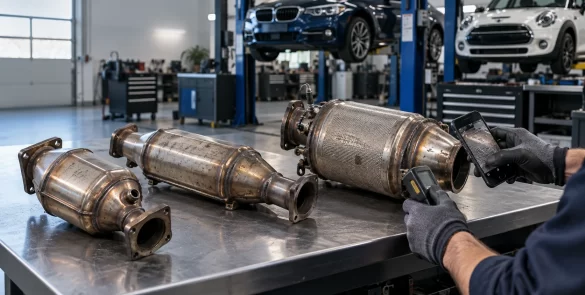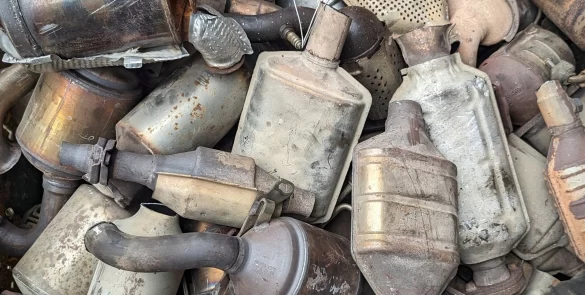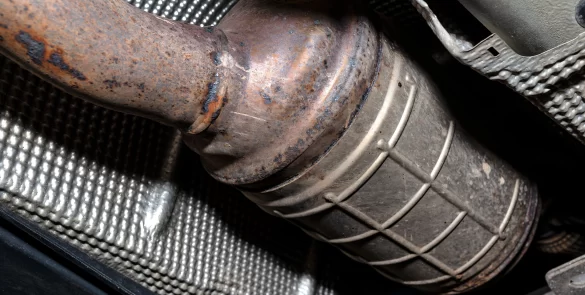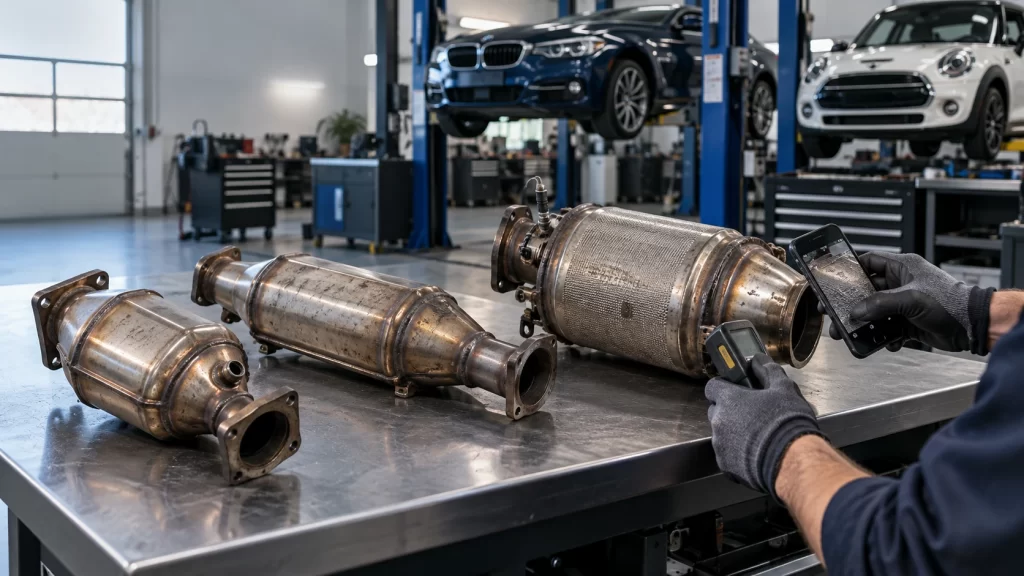

Key Takeaways
- A gasoline catalytic converter and a diesel DPF filter are not the same part.
- The BMW or MINI logo alone does not determine a part’s value.
- An accurate inspection requires the part code and clear photographs.
- A cut, empty, or damaged housing can make evaluation more difficult.
- Value is affected by the part type, contents, completeness, and inspection results.
- The part should not be cleaned, struck, or dismantled before handing it over.
- Compare not only the offered amount, but also the weighing and analysis procedure.
How do BMW and MINI gasoline and diesel exhaust system parts differ?
Gasoline and diesel systems control different emissions, so their design and component sets are not the same. In a diesel vehicle, the catalytic component may be combined with the DPF or located next to it.In a gasoline engine exhaust system, the main element is usually the catalytic converter. Its internal structure contains a coating with metals that help chemically convert harmful exhaust-gas components.A diesel system may include an oxidation catalyst, a particulate filter, and other emissions-control components. The DPF’s main function is to capture soot particles. This does not mean that every DPF is the same or that every diesel part has the same material value.The critical raw materials review published by the European Commission’s Joint Research Centre states that in 2018, automotive catalysts accounted for 86 percent of palladium consumption in Europe and 81 percent of global demand. This shows why recycling used emissions-control parts is an important part of metal circulation.How can you identify a gasoline engine part?
The most reliable way is to identify it by the part code and the vehicle’s technical data. The housing shape alone is not sufficient evidence.Prepare information about the BMW or MINI model, production year, fuel type, and engine version. Then find the marking on the housing. It may be stamped, engraved, or visible on a metal plate. If the marking is covered by rust and dirt, clean only the surface around the code without damaging the housing.How can you identify a diesel DPF assembly?
A DPF assembly can be identified using the part code, pipe layout, sensor locations, and the vehicle’s technical data. A visual guess without a code can be incorrect.A diesel exhaust assembly may have several connections for sensors and pressure pipes. However, the design varies by model and engine. A practical overview of parts for both fuel types is available in the article on how diesel and gasoline catalytic converters differ.Are BMW and MINI parts always valuable?
Which factors have the greatest impact on the evaluation?
The most important factors are the code, part type, presence of internal material, and completeness of the housing. Market conditions matter only together with accurately determined material content.- Part code. It helps locate the relevant database record and reduces the risk of mix-ups.
- Internal contents. An empty or partially removed housing cannot be evaluated in the same way as a complete part.
- Part type. A gasoline converter, diesel catalytic assembly, and DPF perform different functions.
- Physical condition. Damage can make it difficult to identify the part and inspect its contents.
- Analysis method. Documented laboratory testing provides a stronger basis than a visual estimate.
What does a comparison of BMW and MINI parts show?
The comparison shows that each part type requires a different inspection approach. The practical characteristics below can help you prepare for an evaluation.| Part type | Main function | What is needed for inspection | Most common risk |
|---|---|---|---|
| Gasoline catalytic converter | Chemical conversion of exhaust gases | Code, photo of the complete housing, vehicle data | Evaluation based only on the brand |
| Diesel catalytic assembly | Diesel emissions control | Code, engine data, photo of the part | Confusing it with a DPF |
| DPF filter | Capturing soot particles | Code, photos of sensor locations and the housing | Assuming every filter has the same value |
| Combined assembly | Combining several emissions-control functions | Complete markings and professional identification | Incorrectly identifying the assembly configuration |
How is the value of a specific part determined?
Value is determined by first identifying the part and then checking its composition. A reliable offer should not be based solely on the vehicle model or a similar image found online.Catalytic converter prices may vary even within the same make. Therefore, you should send a legible code and several photographs. If the code cannot be identified or the part does not match a database record, additional analysis may be required.Which photographs should you send?
Send one overall photo and several close-ups showing the code, connections, and damage. Images should be sharp and taken in good lighting.- Place the part on a stable, dry surface.
- Photograph the entire housing from both sides.
- Take a straight photo of the marking rather than one from an angle.
- Show cut areas, cracks, or missing parts.
- Include the BMW or MINI model, year, fuel type, and engine information.
Should the part be dismantled before handing it over?
No, dismantling it yourself usually does not help. A complete housing, original marking, and preserved internal material make inspection easier.Do not cut the housing just to inspect the contents. Do not hit the part or shake material out of it. Such actions can create dust, scatter the contents, and make proper accounting more difficult. If the part has already been cut, keep all of its pieces and inform the evaluator.What is the role of the DPF in vehicle inspection?
The DPF is part of the diesel emissions-control system, and the vehicle’s technical condition is assessed according to Latvia’s inspection procedures. Before removing the part, you should determine whether the vehicle will still be used on public roads.Vehicle roadworthiness inspection requirements are set out in Latvian regulations on technical inspections and roadside checks. Therefore, removing emissions-system components should not be viewed solely as a matter of selling metal.If the BMW or MINI is still in use on the road, first consult a qualified auto repair service. However, a part obtained from a dismantled, worn-out, or end-of-life vehicle can be prepared for recycling evaluation. Further information is available in the material on diesel emissions testing and DPF detection in 2026.How do you choose a reliable acceptance facility?
Choose a service provider that clearly explains identification, analysis, record-keeping, and payment procedures. Assess not only the quoted amount, but also how it was determined.Before handing over the part, ask several specific questions:- Is the evaluation based on the part code or on analysis?
- What happens if the code is not legible?
- Will I receive a clear explanation of the evaluation?
- How are the part’s condition and completeness recorded?
- When and how is payment made?
What should you do if the code is not legible?
Send photos of the complete housing and all available information about the vehicle. If visual comparison is not sufficient, the part may require additional inspection.Do not try to guess missing code characters. One incorrect symbol may indicate a different part. Photograph the marking from different angles and use side lighting, which better highlights shallow stamped characters. If the vehicle is still available, keep its technical data together with the part.Summary
BMW and MINI gasoline catalytic converters, diesel assemblies, and DPF filters should not be evaluated using one principle. The brand helps start the search, but the final evaluation requires a code, photos of the complete housing, engine information, and, if necessary, laboratory analysis.Do not divide the part or remove its contents. Preserve the marking, honestly disclose any damage, and compare the transparency of the acceptance process. If you need documented car catalytic converter purchasing, Metalbee can check the part information, compare it with its database, and explain the next steps.FAQ
Is a BMW part always more valuable than a MINI part?
No. The brand alone does not confirm a higher value. The specific code, engine version, part type, presence of internal material, and physical condition must all be considered. Even visually similar housings can differ. Therefore, a proper offer requires identification of the exact part being handed over, rather than comparing vehicle brands alone.
Are a DPF filter and a catalytic converter the same thing?
No. The DPF’s main function is to capture particulate matter produced by a diesel engine, while the catalytic assembly helps chemically convert exhaust gases. In some vehicles, these elements are located together in one housing or very close to each other. This is why the part code and inspection of the complete assembly are more important than external similarity.
Can an evaluation be provided based only on a photograph?
A good set of photographs often helps with initial identification. The entire housing, code, connections, and damage should be visible. However, an image does not always show the condition or composition of the internal material. If the code is not found in the database or the part has been modified, a physical inspection may be needed for a more accurate result.
Can you sell a DPF removed from a vehicle?
A dismantled part can be submitted for evaluation, but the vehicle’s future use and roadworthiness inspection requirements must be considered. If the vehicle will still be used on public roads, changes to the emissions system should first be discussed with a qualified auto repair service. When handing over the part, preserve its code, complete housing, and information about the vehicle from which it was removed.
How can you prepare a BMW or MINI part for evaluation as quickly as possible?
Clean only the area around the marking and take clear photographs from several sides. Note the model, production year, fuel type, and engine data. Do not cut the housing or remove the contents. Then send the information to the evaluator and clarify whether a database check is sufficient or whether the part must be delivered for analysis.