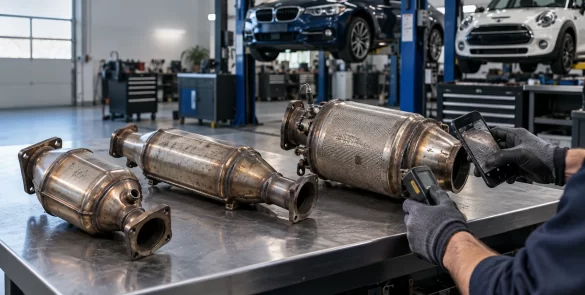
Introduction: catalytic converters are no longer just the domain of passenger cars. They are also used in motorcycles, trucks, buses, work machinery, and certain engines outside everyday road transport. This matters not only because of regulations, but also because this exhaust system component helps reduce harmful substances released into the air while preserving valuable materials for recycling.
- A catalytic converter reduces CO, HC, and NOx emissions.
- It is found not only in cars, but also in motorcycles and machinery.
- Motorcycle, gasoline, and diesel systems differ in design and operating load.
- A worn or damaged unit can cause emissions and performance problems.
- Recycling helps recover valuable metals and reduces waste.
- Before handing one in, proper identification and transparent evaluation are essential.
Why is a catalytic converter important?
A catalytic converter is important because it helps reduce harmful emissions from engine exhaust gases. That is exactly why it is an essential component both for environmental protection and for a vehicle’s compliance with requirements.
The task of a catalytic converter is to reduce compounds such as carbon monoxide, unburned hydrocarbons, and nitrogen oxides. Simply put, it neutralizes part of what would otherwise enter the air in a much more harmful form.
This idea was already strong in the original article, and it remains completely correct today: engine exhaust gases contain harmful compounds, while a quality catalytic converter helps maintain a cleaner environment. The difference today is that the issue is no longer just about a single car part. It is about broader emissions control across the entire transport and machinery ecosystem.
In practice, this means something simple: if the exhaust system works as intended, the vehicle usually causes less environmental harm. That is why a catalytic converter is not a minor add-on. It is one of the main elements in the exhaust gas cleaning chain.
Are catalytic converters only used in passenger cars?
No, they are not. Catalytic converters are used much more widely, including in motorcycles, trucks, buses, agricultural machinery, and some marine engines.
This is one of the most important points worth keeping from the previous version. Catalytic converters are indeed found across a much broader range of vehicles than many assume. In motorcycles, they are usually smaller, but their function remains just as important. In heavier machinery, the systems are larger and often more complex, because engine loads and operating conditions also differ.
According to the US EPA, emission standards apply to both on-road and off-road vehicles and engines. This clearly shows that exhaust control is not just a passenger car issue. Meanwhile, requirements for motorcycles and other L-category vehicles in the European Union are set out in the regulation published by EUR-Lex.
From the user’s point of view, this means something very practical: if a vehicle has an exhaust gas cleaning system, then this component also has technical and material value. That is exactly why catalytic converters attract interest not only from repair shops or dismantling companies, but also from motorcycle owners, fleet operators, and machinery holders.
Which vehicles most commonly have a catalytic converter?
They are most commonly found in passenger cars, motorcycles, freight transport, buses, and work machinery. Depending on the engine type, both the size and the complexity of the system vary.
Looking at it practically, in passenger cars the catalytic converter is often the best-known example. But in motorcycles it is also important, because it helps meet emission requirements in a smaller and more compact system. In trucks and industrial machinery, these components tend to be more robust, designed for longer operation and greater temperature fluctuations.
Overview of vehicle and catalytic converter types
| Vehicle type | Typical feature | Why is the catalytic converter important? |
|---|---|---|
| Motorcycle | Compact exhaust system | Helps reduce emissions in limited space |
| Passenger car | Daily traffic load | Ensures lower emissions and compliance with requirements |
| Truck | High mileage and heavy load | Reduces pollution during intensive operation |
| Bus | Urban routes and frequent operation | Reduces the impact of emissions in densely populated areas |
| Agricultural or construction machinery | Work in dusty and harsh environments | Helps control emissions in off-road machinery |
| Marine engine | Specific operating conditions | Can be part of an exhaust cleaning solution |
How does a catalytic converter work?
The short answer: it promotes chemical reactions that make harmful substances less harmful. This does not mean emissions disappear completely, but their composition becomes significantly more environmentally friendly.
Inside a catalytic converter, reactions take place that help reduce carbon monoxide, hydrocarbons, and nitrogen oxides. For it to work properly, both the engine’s technical condition and the overall state of the exhaust system are important. If the engine is not operating correctly, emissions control will usually not be optimal either.
That is exactly why a catalytic converter should not be seen in isolation. It works as part of the overall system. If the fuel supply, ignition, or other assemblies create deviations, the problem is often reflected in the exhaust results as well.
From a recycling perspective, what matters is that these units contain valuable metals that are not simply waste after the end of their service life. That is why a catalytic converter is both a technically important component and a valuable one from a recycling standpoint.
How do motorcycle, gasoline, and diesel systems differ?
They differ in size, operating load, and system design. Motorcycle solutions are usually more compact, while diesel engine exhaust systems are often more complex.
In a motorcycle, space is limited, so the entire assembly is compact and sensitive to proper design. Gasoline car solutions are the most familiar to many people because they are often found in everyday transport. Diesel engine systems, meanwhile, tend to be more technically nuanced and more dependent on the overall emissions control architecture.
If you want to explore these differences in more detail, the comparison on the differences between diesel and gasoline catalytic converters is useful. It helps explain why one component cannot be evaluated using the same criteria as another.
From a recycling perspective, these differences are especially important. Different models, different construction, and different composition mean that evaluation cannot be the same for all of them. That is why a proper process always starts with identification, not guesswork.

Why is catalytic converter recycling so important?
Because recycling reduces waste and allows valuable materials to be recovered. This benefits both the environment and the circular economy.
A catalytic converter’s life does not end when it is no longer suitable for use. On the contrary, even after use it may still contain materials that can be recovered and used further. That is why handing it over for proper recycling is a much smarter choice than storing it in a warehouse corner or disposing of it irresponsibly.
A broader context matters here as well. The circular economy is not just a modern term. It means less wastefulness, less unnecessary waste, and more efficient resource use. This is exactly the approach supported by the article on the environmental and economic benefits of catalytic converter recycling.
The original article’s idea of more sustainable resource management remains highly relevant. The more catalytic converters enter proper recycling, the fewer valuable materials are lost and the lower the environmental burden becomes.
How are evaluation and recycling carried out?
Usually, everything starts with accurate identification and composition assessment. A fair process is based on data, not assumptions.
In practical evaluation, the catalytic converter’s origin, model, condition, and material composition all matter. That is why serious recycling companies use databases, a laboratory-based approach, and a clear acceptance procedure. This is exactly where quality creates the biggest difference between a superficial inspection and a professional assessment.
Metalbee operates in Latvia and specializes in the purchase and recycling of catalytic converters, printed circuit boards, and various non-ferrous metals. The company’s approach is based on responsible resource management, transparency, and the safe reuse of materials. This is important for customers who want to understand exactly what happens to the material they hand over.
If you are looking for a specific service, catalytic converter purchasing usually starts with verifiable identification and a clear evaluation process. In its work, Metalbee uses an extensive database with more than 30,000 analyzed units, which helps determine a part’s content much more accurately.
This is also the stage when people most often look for catalytic converter prices or compare catalytic converter purchasing prices. However, a proper result should not be based only on a general market phrase. The decisive factors are the specific model, the actual composition, and the quality of the evaluation.
A good process is clear and predictable. The customer understands what is being evaluated, why it is being evaluated that way, and what the next step is. Transparency is especially important in this industry because it helps avoid unclear transactions and superficial guesses.
What is worth knowing before handing over a catalytic converter?
Before handing it over, it is worth finding out the part’s origin, condition, and evaluation procedure. The more clarity there is before the transaction, the fewer misunderstandings there will be afterward.
First, it is useful to understand which vehicle the unit comes from. A motorcycle, passenger car, or heavy machinery component is usually not evaluated according to one template. Next, it is important to choose a company that can explain the process, not just give a quick assumption.
A company’s specialization is also a good indicator. If a recycler works daily with catalytic converters, PCBs, and non-ferrous metals, that usually means broader material expertise and a more organized acceptance process. Attitude matters too: clear explanations, proper acceptance, and an understandable settlement procedure.
One more practical point: this component should not be viewed only as a worn-out car part. It is a material with recycling potential. That is why proper handover is not just a technical step, but also a responsible choice.
What role does Metalbee play in this field?
Metalbee acts as a recycling partner with an emphasis on transparency, sustainability, and proper evaluation. This is important for customers who want a safe and understandable process.
The original article already emphasized that Metalbee offers a fair and clear approach. This idea is worth keeping because it aligns with the company’s publicly described operating model. The company focuses on responsible reuse of resources, high service quality, and a fair settlement approach.
This is especially important in an industry where customers often want not only to hand over material, but also to understand what happens next. Clear communication, a laboratory-based approach, and specialization help build trust in the process. Therefore, in this context, Metalbee is not just a collection point, but a recycling partner with a specific industry focus.
Summary
A catalytic converter is an important exhaust system component not only in passenger cars, but also in motorcycles, freight transport, buses, and work machinery. Its main task is to reduce harmful emissions, but after the end of its service life this component also retains recycling value.
Looking at the bigger picture, this is about three things at once: environmental protection, technical correctness, and smart resource reuse. That is why, before handing over a catalytic converter, it is worth understanding its origin, choosing transparent evaluation, and working with a specialized partner. This approach is sensible both in practical terms and in the long run.