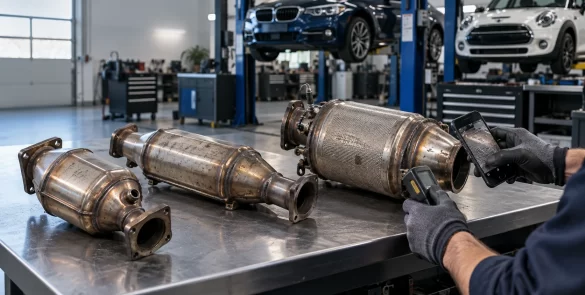
Introduction: Today, emissions standards are becoming stricter, and car owners are increasingly thinking not only about repairs but also about the proper disposal of used parts. That is why it is important to understand the differences between diesel and gasoline engine catalytic converters, how they work, and why they cannot be evaluated based on fuel type alone. For those interested in catalytic converter buying and catalytic converter prices, the main rule is simple: the decisive factors are the unit’s design, the content of active components, and accurate model identification, not common myths from the internet.
- Diesel exhaust aftertreatment systems are usually more complex and often work together with DPF and SCR.
- Gasoline cars more often use a three-way exhaust neutralization system.
- Engine type alone does not show the real recycling value of the unit.
- Accurate evaluation requires markings, the vehicle model, and laboratory testing.
- It is better to hand over a catalytic converter as a complete unit, without unnecessary disassembly.
- Recycling helps return valuable materials to circulation and reduces waste volume.

Diesel catalytic converters: key features
In basic terms, the original point is correct: a diesel engine operates differently from a gasoline engine, and its exhaust composition is different as well. Diesel exhaust usually contains more nitrogen oxides and particulate matter. That is why in such vehicles the cleaning system often consists not of one element, but of several units working together.
One important element is the diesel oxidation catalyst. According to DieselNet, this unit helps reduce CO and HC emissions and also participates in processes related to further exhaust cleaning. In practice, this means that a diesel system is often designed as a chain of interconnected components rather than as one universal block.
In addition, diesel vehicles often include a diesel particulate filter — DPF. Its task is to capture solid particles. As Corning notes, a DPF traps soot and thereby reduces particulate emissions into the atmosphere. In more modern systems, this is complemented by SCR, where a reagent is used to reduce NOx.
Because of these features, a diesel unit often appears more complex in terms of both design and the composition of the entire exhaust system. However, this does not mean that any diesel catalytic converter will automatically receive a higher valuation. For a recycler, what matters is not guesswork but the exact model, housing type, origin of the part, and analysis results.
What does this mean for the owner?
If you have a diesel vehicle, you should not assume that the mere presence of a DPF or SCR makes the unit more valuable. It is far more useful to preserve the markings, avoid disassembling the part unnecessarily, and clarify in advance whether the specific element is evaluated separately or as part of the overall system.
Gasoline catalytic converters: how do they work?
A gasoline engine produces a different emissions profile. Here, the key pollutants are usually carbon monoxide, hydrocarbons, and nitrogen oxides. That is why gasoline vehicles widely use a three-way catalytic converter, which helps reduce all three groups of substances at the same time.
Gasoline systems are the ones most often associated with the classic automotive catalytic converter that owners mention when replacing or selling a used unit. Inside these devices, precious metals are used, which is what makes recycling economically significant. But here too, one clarification matters: value is determined not by the name of the part, but by its specific composition and design.
In everyday practice, a catalytic converter on a gasoline engine is often easier for the owner to understand. It is not always connected to as many additional elements as a diesel cleaning system. That is why many people think it is easier to evaluate. This is partly true, but only at the initial stage. The final valuation must still be based on the part number, the origin of the unit, and laboratory data.
Is the gasoline option always more profitable?
No. You need to compare not by fuel type, but by the specific catalytic converter model. One gasoline unit may be less attractive for recycling than another, while some diesel solutions, on the contrary, require more detailed analysis because of their complex design.
How is a diesel catalytic converter different from a gasoline one?
The short answer is this: a diesel system is more often designed to deal with soot and NOx, while a gasoline system is aimed at simultaneously reducing CO, HC, and NOx within the more familiar three-way setup. This matters to the owner because parts that look similar externally can differ greatly in purpose and in the way they are evaluated.
Another practical difference is that a diesel vehicle often has several components working in sequence. The gasoline option is usually seen as a more integrated and understandable unit. However, for recycling, the same approach is needed in both cases: precise identification instead of assumptions.
Comparison table: design, functions, and recycling features
| Parameter | Diesel | Gasoline | What matters when handing it over |
|---|---|---|---|
| Main pollutants | NOx, particulate matter, CO, HC | CO, HC, NOx | Exhaust composition affects the type of system installed |
| Typical cleaning setup | DOC, DPF, sometimes SCR | Most often one main TWC catalytic converter | You need to understand exactly which unit you are removing |
| System complexity | Often higher due to multiple elements | Usually simpler for initial identification | A complex system does not equal an automatically higher valuation |
| Valuation approach | Markings, model, laboratory analysis | Markings, model, laboratory analysis | Precise identification is equally important |
| Common myth | If the unit is more complex, it is always more valuable | If it is gasoline, the valuation is always higher | Both claims are incorrect without checking the specific part |
Can you evaluate a catalytic converter only by engine type?
No. This is the most common and the most costly myth in terms of consequences. Engine type gives a general idea of the cleaning system, but it does not replace an accurate valuation. Even within the same brand and the same vehicle generation, different solutions may be used.
If you want to understand more deeply why comparing “diesel vs. gasoline” does not always work, it is useful to study a breakdown of the factors affecting the value of diesel and gasoline catalytic converters. This approach helps you look at the part professionally rather than relying on hearsay.
What affects the valuation when selling?
Put simply, the final valuation depends not on one property but on a combination of characteristics. Here is what really matters:
- the make and model of the vehicle;
- identification by number or marking;
- the type of unit and its place in the exhaust system;
- the condition of the part;
- laboratory confirmation of its composition.
That is why companies that work professionally rely not on rough comparisons but on databases and analysis. For Metalbee, this is especially important: the company specializes in catalytic converter buying and recycling and also uses an extensive database of more than 30,000 laboratory-analyzed converters. This approach helps avoid guesswork and makes the valuation clearer for the customer.
How can you quickly understand which unit you have?
Take three simple steps. First, check the vehicle model and engine type. Then find the marking on the part housing, if it is still visible. After that, pass the information to a specialist together with photos. This is faster and more accurate than trying to determine value by size, weight, or forum advice.
Why is catalytic converter recycling important beyond just the payout?
The financial interest is understandable, but it is not the only reason. Recycling returns useful materials to industrial circulation and reduces waste volume. This is especially important for parts containing valuable active components, the recovery of which from secondary raw materials helps use resources more efficiently.
If the environmental aspect matters to you, take a look at material on why catalytic converter recycling is important for ecology and the economy. For a private owner, this is a good way to understand that handing over an old part is not just a routine action, but part of a broader chain of responsible resource use.
Why do owners and companies choose Metalbee?
In the updated version of the article, the main point should be preserved: Metalbee operates in Latvia as a recycling company focused on transparency, safe operations, and fair material valuation. The company works not only with automotive catalytic converters but also with PCB boards and various non-ferrous metals. This matters because experience in several recycling areas usually means a more systematic approach to raw material analysis.
For the catalytic converter topic, two advantages are especially significant. First, there is modern laboratory testing. Second, there is a large database of already analyzed converters. As a result, the customer receives not an approximate opinion, but a valuation based on data. This format is especially useful for private sellers, car repair shops, and dismantlers who value predictability and transparency in the process.
That is why, when choosing a company to sell a unit to, it is worth looking not only at promises but also at the working method. When valuation is based on laboratory testing, a reference database, and clear communication, the risk of mistakes is significantly lower.
How should you prepare a catalytic converter for sale?
The best option is not to overcomplicate things. Do not try to determine the composition yourself, do not rely only on the external appearance, and do not draw conclusions based on fuel type alone. Prepare the vehicle information, preserve the marking if possible, and submit the part for inspection in the condition in which it was removed.
- Keep the part number or visible marking.
- Provide the make, model, and engine type of the vehicle.
- Do not rely on general internet tables without confirmation.
- Request a valuation for the specific unit, not for the general category of “diesel” or “gasoline.”
- Choose a company that uses a laboratory-based approach.
Summary
Diesel and gasoline engine catalytic converters do indeed differ in both function and design. Diesel systems more often operate together with DPF and other cleaning elements, while gasoline vehicles usually use a three-way exhaust neutralization setup. But for recycling, the main conclusion is different: you cannot evaluate a unit only by whether it is diesel or gasoline.
If you are interested in catalytic converter buying and catalytic converter prices, focus on precise identification, the condition of the part, and laboratory testing. This is exactly the approach that helps ensure a correct valuation while also supporting responsible material recycling.